You pause the ads for a week. Traffic drops to almost nothing. The enquiries stop.
That is when owners realise how much of their pipeline is rented, not owned.
Ads are fast and measurable. The trouble starts when the budget runs out, or your cost per click doubles in a competitive month.
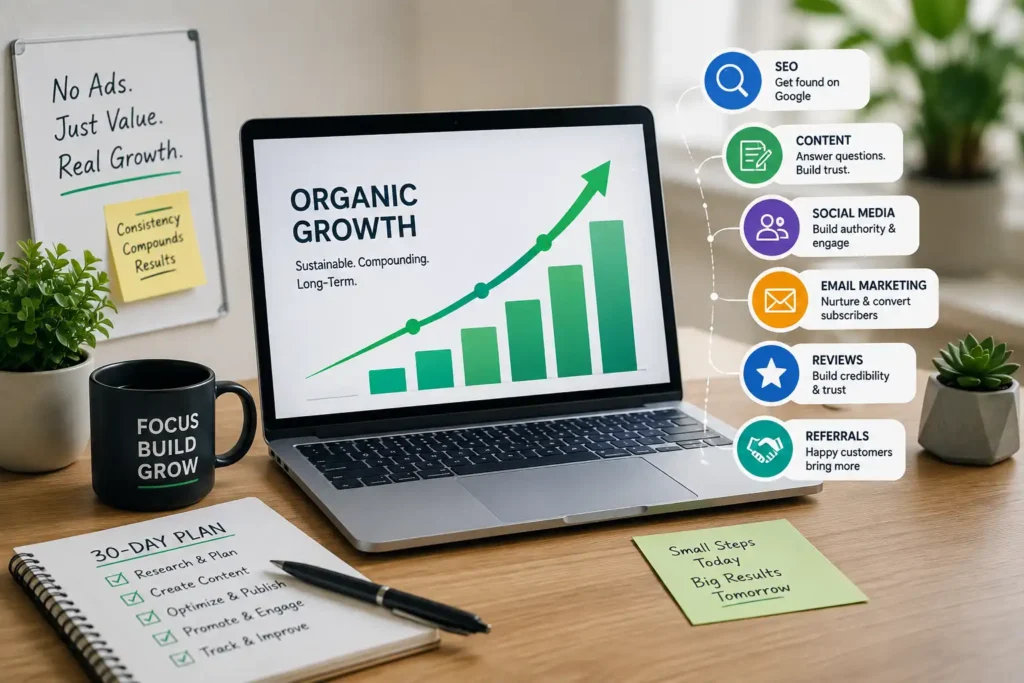
Organic marketing is the other route. It starts slow and compounds, the opposite shape of a paid campaign. Plenty of businesses run both, but the organic side comes first so the ads have something to stand on.
Here are 10 organic marketing strategies you can run yourself, plus a 30-day plan.
If you’re wondering how to get customers without ads, you’re at the right place. Many small businesses grow entirely through search, content, reviews, referrals, and email. Organic marketing costs time instead of ad spend, so results build over months rather than appearing the day you switch it on. Most owners see real movement between month three and six.
Can You Really Grow a Small Business Without Ads?
Yes, though how quickly depends on your industry, your location, and how many competitors already publish.
There’re two honest caveats.
- Organic marketing is not free; you pay in hours and consistency instead of clicks.
- A page you publish today might bring its first customer in month four.
What makes it worth the wait is that every review, article, and referral partner keeps working after you stop touching it.
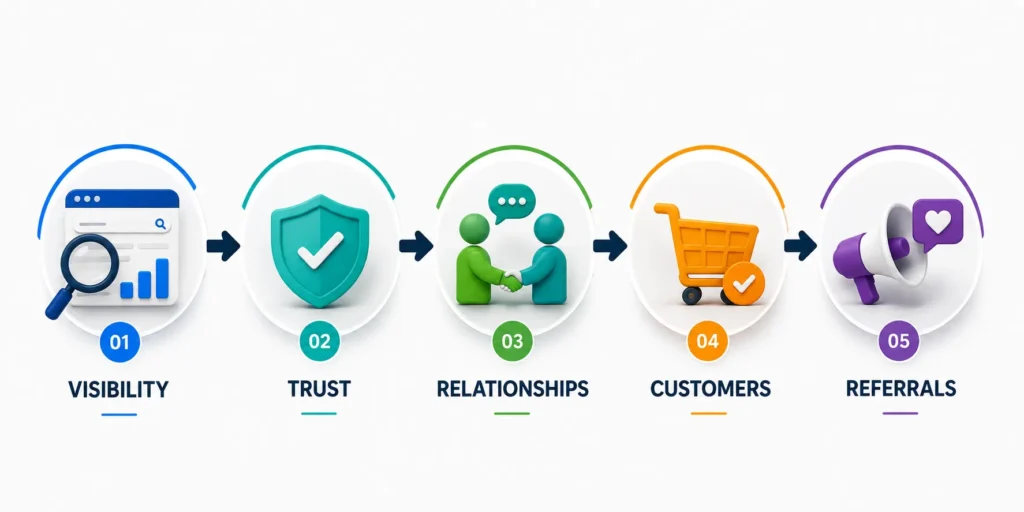
Skipping a step rarely works. Nobody refers a business they have not learned to trust.
What Is Organic Marketing?
Organic marketing means attracting customers through channels you do not pay a platform to place you in: search, blog content, your Google Business Profile, social posts, email, reviews, referrals and partnerships.
Ads buy attention for as long as you keep paying. Organic marketing earns it slowly and keeps it after you stop.
Organic Marketing Vs Paid Marketing
Organic and paid marketing can both bring customers, but they work differently. Organic marketing builds visibility and trust over time, while paid marketing helps you reach people quickly by paying for traffic.
Factor | Organic marketing | Paid advertising |
Speed | Slow at first, builds over months | Traffic on day one |
Cost | Time and consistency | Ongoing budget |
When you stop | Content keeps working | Traffic stops immediately |
Trust | Earned through content and reviews | Depends on the landing page |
Best for | Long-term visibility and authority | Launches, promotions, and testing offers |
Neither wins outright. The question is which you build first.
10 Organic Marketing Strategies for Small Businesses
Small businesses don’t need a huge marketing budget to attract customers. Organic marketing focuses on channels such as SEO, content, social media, reviews, and referrals to build visibility without paying for every click. Here are 10 practical organic marketing strategies small businesses can use to reach the right audience and generate consistent growth.
1. Use SEO to Get Found by People Already Searching
Most small business websites describe what the business does, not what customers type into Google.
Pick one primary keyword per page, with buying intent behind it. “Digital marketing” is broad and unwinnable. “Social media management for restaurants in Delhi” is neither. Put that phrase in your title tag, your single H1, and a subheading, then link related pages to each other. Our beginner SEO checklist covers the rest.
Quick win: write down five questions customers ask before they buy. Each one is a page.
2. Turn Local SEO into a Customer Discovery Channel
For most local businesses, the Google Business Profile brings in more enquiries than the website does in year one. It is free, and most owners fill in about half of it.
Complete every field: category, services, hours, service areas, real photos of your work. Reply to every review, including the unflattering ones. Then back it up with location pages, where a proper local SEO strategy earns its keep.
Mini challenge: search “[your service] near me” on your phone. Are you in the map pack?
If you want help turning these tactics into a consistent search strategy, explore our SEO services for small businesses.
3. Create Helpful Content Around Real Customer Questions
Most small business blogs fail because they are written for search engines. Follow the customer’s question instead.
Question to Answer to Solution to CTA
One question stretches further than you expect. “How much does a website cost?” becomes a blog post, an FAQ entry, an Instagram carousel, a short video, and an email. A good blog structure for SEO helps each piece stay useful to both readers and search engines.”
Answer it in the first two lines. That is the part AI Overviews and ChatGPT pull from, which is the core of answer engine optimisation.
Common mistake: 800 words of preamble first.
4. Use Social Media to Build Trust, Not Just Followers
Followers are an audience number. Trust is what makes someone send you a message.
Rotate four kinds of posts: teach something useful, show the work happening, prove it with a result or testimonial, then engage in comments and DMs. These Instagram marketing tips for small businesses show how to turn that approach into a consistent content rhythm.
Teach → Show → Prove → Engage\
If you need a repeatable system for planning, publishing, and engaging, our social media services can take the day-to-day work off your plate.
Behind-the-scenes content does more for a service business than polished graphics, because it answers what buyers quietly want to know: is this person good at their job?
Quick win: post one real customer question and your answer this week.
If you’re deciding which social platform deserves your limited time, compare Instagram vs Facebook marketing before trying to maintain both.
5. Turn Happy Customers into Your Marketing Team
Word of mouth is already happening around your business. Most owners never ask for it in writing.
Great experience → review → trust → new customer → new review
Ask when the customer is happiest, right after you deliver. Send a direct link and keep it a two-minute job. For referrals, ask specifically: “Do you know anyone else dealing with this?” beats “send people my way.”
Never buy reviews or write your own. Google removes them, and customers spot them.
6. Build an Email List You Own
If your Instagram account disappeared tomorrow, how would you reach the people who already know your business?
Website visitor → lead magnet → subscriber → relationship → customer
The lead magnet only needs to be useful and small: a checklist, a pricing guide, a free 15-minute consultation. If you’re starting from scratch, this guide explains how to build an email list step by step. Then email consistently, even if that means monthly. A list of 200 people who chose to hear from you beats 5,000 followers who scrolled past.
7. Repurpose Content Instead of Constantly Creating More
Most owners quit content marketing because they think it demands a new idea every week. It does not.
One article becomes three social posts, two short videos, one email, one LinkedIn post, and three Pinterest pins. Same idea, different formats, spread across a month.
Create once, distribute many times. Tools such as Canva can make that repurposing process much easier for small teams.
8. Collaborate with Businesses That Already Have Your Audience
You do not always need a bigger audience. Sometimes you need access to the right one.
Photographers and makeup artists. Web designers and copywriters. Fitness coaches and nutritionists. Real estate agents and interior designers. Same customer, no competition.
What works: a referral arrangement with clear terms, a joint workshop, or a bundled offer.
Quick win: list five businesses your customers already buy from. Message one this week.
9. Choose the Right Organic Channels Instead of Being Everywhere
Trying six platforms at once is how most small businesses burn out by month two.
Pick three: one discovery channel, one relationship channel, one you own.
Google, Instagram, and email
Or YouTube, LinkedIn, and email
Which three depends on where your buyers spend time, not on what is trending.
10. Connect Everything into an Organic Marketing System
Separately, these tactics are ordinary. The compounding comes from wiring them together.
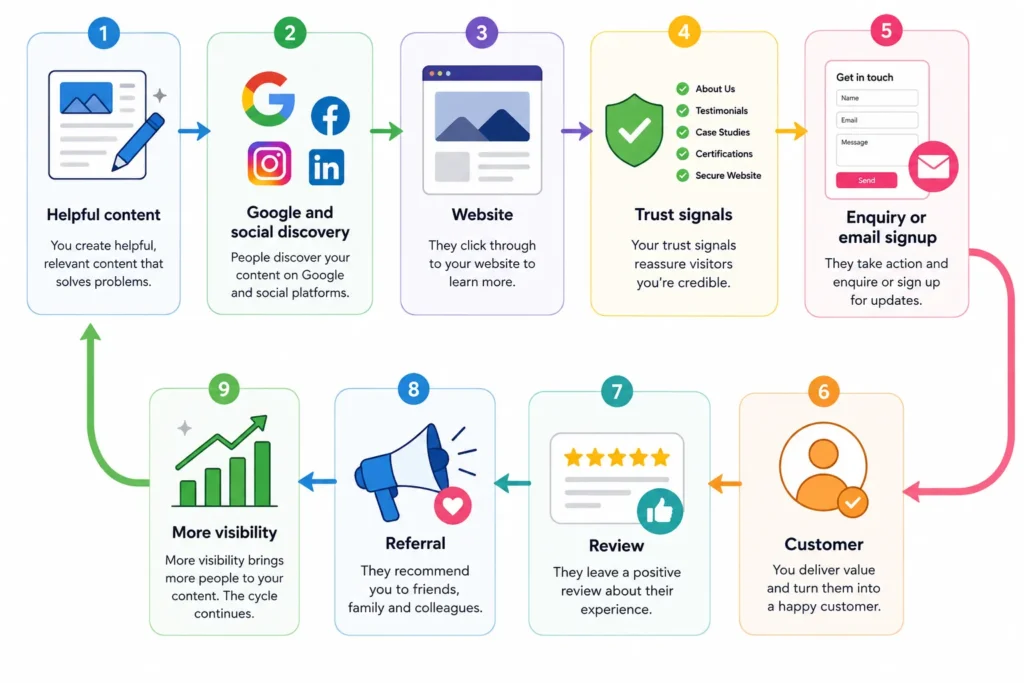
A new review strengthens your local SEO. Stronger local SEO sends more visitors; more visitors mean more subscribers, and subscribers refer people. That loop is why owners who stay with organic growth for a year rarely go back to ads alone.
Which Organic Marketing Strategy Should You Start With?
The best organic marketing strategy depends on where your business is starting from. If your customers search for services online, opt for local seo.
If you sell services/product/offerings beyond your local area, SEO and content marketing can help you build visibility. The key is to choose strategies that match where your customers.
Do not attempt all ten at once. Pick two and give them 90 days.
Your 30-day organic marketing plan
Week 1: get found. Audit your website basics (titles, mobile, speed), complete your Google Business Profile, and note the terms customers search for. You can use Google Analytics alongside Search Console to understand what happens after those visitors arrive.
Week 2: get helpful. Collect 10 real customer questions, write one strong article answering the biggest, then cut it into social posts.
Week 3: build trust. Ask five past customers for reviews, publish testimonials on your services page, and reply to every comment and DM.
Week 4: build relationships. Add a lead magnet and email signup, then contact three complementary businesses.
Then repeat weeks two to four. Two strategies run for a quarter beat ten sampled for a fortnight.
Organic Marketing Vs Paid Advertising: Which Is Better?
Organic marketing is better for long-term visibility, authority, and traffic that does not vanish when a card payment fails. Paid is better for speed: a launch, a promotion, or testing whether an offer converts. Before increasing ad spend, it’s worth understanding common Google Ads mistakes that can make campaigns more expensive than necessary.
The sensible sequence is organic first, paid on top. Ads pointed at a website with no reviews and no clear positioning cost more per lead than they should. A joined-up digital marketing plan uses both, in that order.
How Long Does Organic Marketing Take to Work?
Three to six months is realistic for search-driven results. Google Business Profile improvements can show up within weeks, and referrals or email can produce a customer the same week you start asking.
What changes that timeline: your industry, how competitive your area is, how authoritative your website already is, and how consistent you are.
Anyone promising a fixed number of leads by a fixed date is guessing.
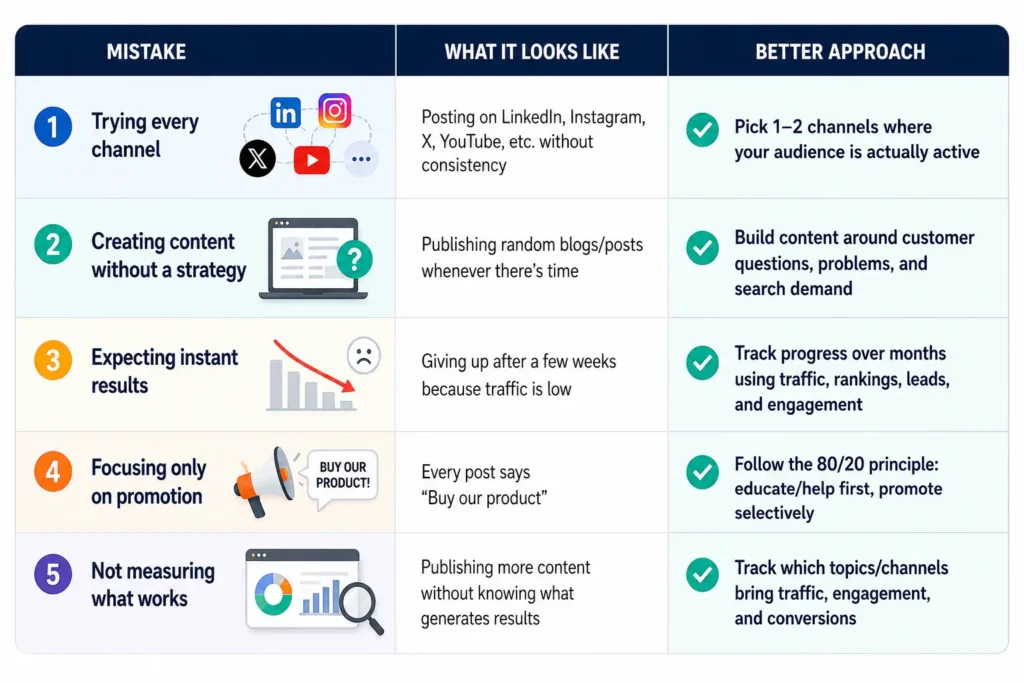
5 Organic Marketing Mistakes Small Businesses Should Avoid
- Being on every platform. Three channels run properly beat six run occasionally.
- Posting without a plan. Random content builds a feed, not a pipeline.
- Creating content nobody searches for. Check the question is asked first.
- Ignoring reviews and local SEO, usually the fastest win available and the one most often skipped.
- Stopping at month two, normally just before the work starts paying off.
Final Takeaway
You don’t need more marketing. You need a better system.
Ten strategies is a menu, not a to-do list. The businesses that grow without heavy ad budgets become easier to find, easier to trust, and easier to recommend, then keep doing that while competitors chase the next platform.
Three things to do next:
Today: find one question your customers search for.
This week: publish one genuinely useful answer to it.
This month: build one repeatable system for reviews, referrals, or email.
If you would rather someone handle the organic side while you run the business, explore our content marketing services or SEO services to build a consistent organic growth system.
Frequently Asked Questions About Organic Marketing
What is organic marketing?
Organic marketing is attracting customers through unpaid channels: search, content, social media, email, reviews, and referrals. You invest time instead of ad budget.
How can I grow my small business without ads?
Become findable through SEO and your Google Business Profile, answer real customer questions in your content, then collect reviews and emails so past customers send you new ones.
How do I get customers without advertising?
Reviews and referrals convert fastest. Ask satisfied customers for reviews, ask directly for introductions, and keep your Google Business Profile complete.
What are the best organic marketing strategies?
For most small businesses: local SEO, content built around customer questions, reviews and referrals, and an email list you own.
Can I market my business for free?
Almost. Google Business Profile, Search Console, and most email tools have free tiers. The cost is your time.
Is organic marketing better than paid advertising?
Neither is better outright. Organic builds assets that keep working after you stop; paid buys speed. Most businesses use organic as the foundation, paid for launches.
How long does organic marketing take to work?
Usually three to six months for search results, faster for Google Business Profile changes and referrals.
What is the easiest organic marketing strategy for beginners?
Completing your Google Business Profile. It takes an afternoon, costs nothing, and, for local businesses, often determines whether a customer finds you.