

Are you feeling lost after your first blog post?
Well, you are not alone.
Actually, more than 80% of new bloggers find it difficult to earn a profitable income and sometimes no income at all.
You could be tempted by the hundreds or thousands of dollars that successful bloggers make each month.
When you first start blogging, it could seem intimidating, but after you figure it out, it’s a very different story.
If you’re just getting started, having a strong foundation in digital marketing for beginners will make these blogging mistakes much easier to avoid.

Do not worry!
By avoiding the below 10 common yet most crucial blog writing mistakes, you are going to save effort, time, money, and frustration.
These blog writing mistakes are common among new marketers, but they’re also the easiest to fix once you spot them early.
Table of Contents
Understanding these blog writing mistakes early can prevent long-term SEO, traffic, and engagement issues.
Come on! Let’s start from the basics.
1. No Clear Goal
All good performance starts with a clear goal-Kenneth H.Blanchard
Starting a successful blog on the very first day is virtually impossible. However, the success of blogging for beginners depends on establishing a clear goal.

- You will be confused and not motivated enough if you lack a defined objective, and you won’t get any readers for your blog.
Tips:
✔️ Determine your target audience and what you hope to create.
✔️Create SMART objectives.(specific, measurable, achievable, relevant, and time-bound).
✔️Craft a content strategy that actually will work.
2. Neglecting Audience Research and Competitor Analysis
- Ignoring audience research will hinder the blog’s relevance, growth, and effectiveness.
- Neglecting competitor analysis, a crucial step, makes you miss immense opportunities and makes your blog less competitive.
Your blog will be filled with irrelevant content that doesn’t engage the right readers if you skip these two.

Practical tips:
✔️Consider who you want to reach? What are their interests, needs, and pain points?
✔️This step helps beginner bloggers to identify gaps, guide keyword selection, content topics, and niches, thereby creating more growth opportunities.
3. Blogging without a Niche
A blog without a niche is like a boat without a rudder.
Building a niche will give you direction for your blog and should be the sole focus of your website. Because without a niche,
- Your blog will be unable to stand out in the competitive blogging market, and limit your growth potential.

Tips:
✔️Write blogs about a niche you are enthusiastic about and draw in a dedicated readership.
✔️Make search engines recognise your website as authoritative and reliable with extensive coverage of your niche blogs.
4. Poor Content Quality
“A blog without quality content is like Baingan Bharta without the Baingan — it just doesn’t make sense.”
Quality Content is the backbone of any website.
When your writing lacks quality,
- It affects website analytics, loses the audience’s interest and trust, harms one’s reputation, and reduces the value of your site.

Tips:
✔️Create focused, well-crafted content.
✔️Curating high-quality content is your asset, and that establishes authority in your field.
5.Structural and Formatting Mistakes
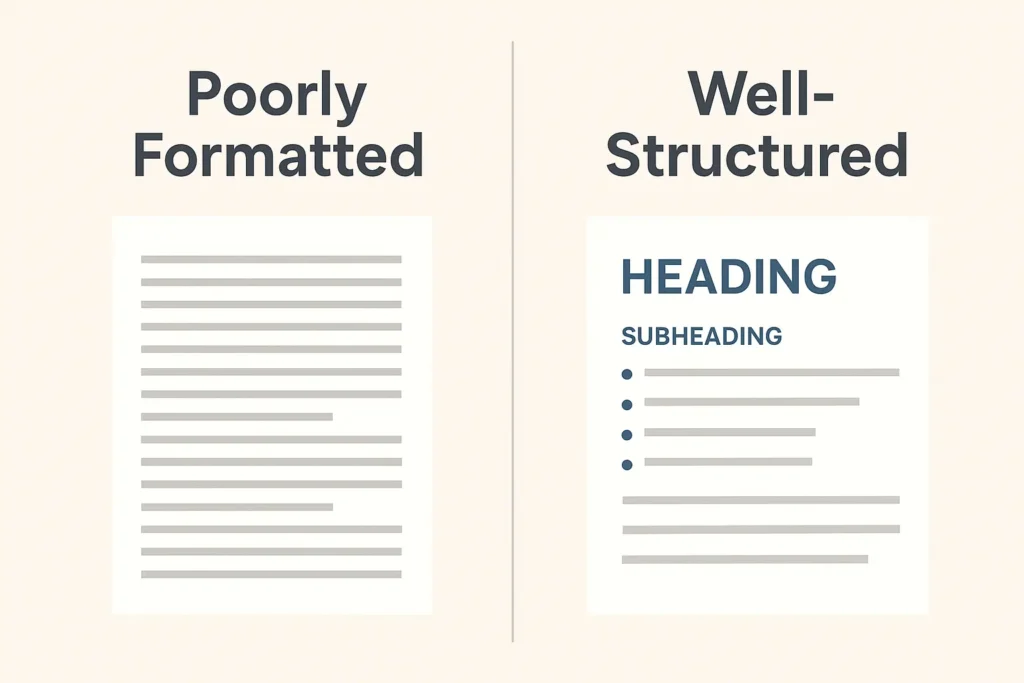
- Structural and formatting mistakes make blogs hard to read and drive away visitors.
- They may have poor grammar, clogged sentences, sentence overload in each paragraph, making readers too difficult to understand, or even adding loads of technical details in the blog.
Balancing quality information with a structured flow is a fundamental skill in blogging.
Many blog writing mistakes stem from poor structure, which affects both readability and search visibility.
This is where following a proven blog structure for SEO helps readers scan better and keeps them engaged longer.
Tips:
✔️State the purpose clearly and enhance your content with a logical flow.
✔️Provide a captivating introduction, clear main content, and an apt conclusion.
✔️Use fonts that are readable and simple with clear designs.
✔️Establish appropriate line and paragraph spacing, as well as a strong contrast between the text and background.
✔️ Make sure your headers and subheadings follow a hierarchy. Additionally, write precise headlines, reflect your content, and speak to the reader’s intent.
✔️ Pictures ought to relate to the text. Include balanced, framed photos and the most appropriate background.
6.Ignoring SEO Best Practices
If you do not consider search engine optimisation for your website and blogs,
Then you are really going to stay behind the big picture.

- Without On-page SEO, your blog will rank low in search engines, thus hindering organic traffic.
- Ignoring mobile optimisation will also raise bounce rates.
Tips:
✔️Prioritise user experience by providing and optimising a clear structure, headings, content, and fast page speed.
✔️Get help from smart tools like Semrush, Yoast SEO, and Google Search Console for proper optimization.
✔️Using precise formatting, meta descriptions, and crucial keywords helps to raise your site’s search engine rankings.
Read our Beginner SEO Guide to know how to ace the search engine game.
7. Lack of Internal and External Linking
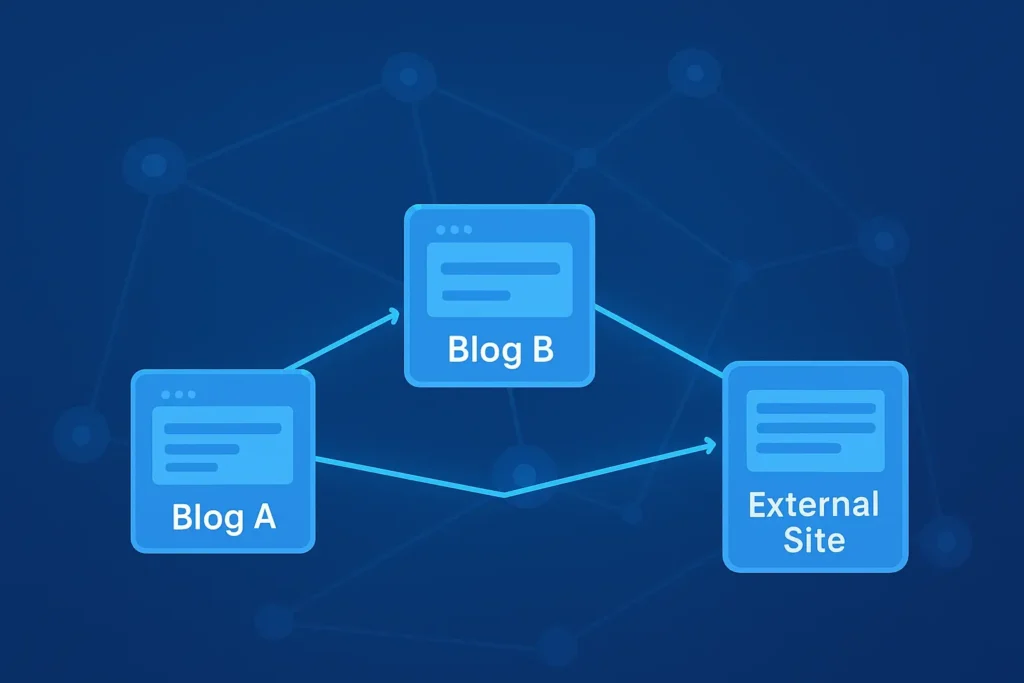
- Lack of internal and external linking in your blogs impacts user experience negatively, losing site visibility, credibility, and authority.
Tips:
✔️Well-placed internal linking enhances your blog’s trustworthiness and improves navigation.
✔️Pertinent external linking increases your SEO score and results in backlinks.
Tick the Off-Page SEO checklist before you hit the publish button.
Want to Know Why Blog Structure for SEO Matters More Than Ever? Read Here.
8. Ignoring Analytics and Feedback
Analytics and feedback are the foundation step to reveal critical issues and hidden opportunities. Ignoring analytics and feedback,
- It will make your site lose clarity, precision, confidence, and speed.
- Also prevents continuous improvement, cannot explain failures, and decreases engagement due to inconsistent content.

Tips:
✔️Incorporate regular monitoring to get real-time insights into engagement rates and conversion rates.
✔️Get help from free tools like Google Analytics, Hotjar, and refine the content strategy whenever required.
✔️Engage with both positive and negative feedback to boost loyalty, retention, and drive innovation.
9. Privacy
- When you have no privacy settings, your website can trigger data audits, financial penalties, and data mismanagement accusations.
- This can lead to hacking, loss of users’ trust, reduced engagement, and affect the reputation of your site.

Tips:
✔️Prevent legal hassles by including a simple privacy policy.
✔️Create strong passwords, maintain software updates, and install security plugins.
✔️Use plagiarism detection software, produce original content, and credit your sources.
✔️Get proper permissions wherever and whenever necessary.
10: Inconsistent Posting Schedule
- Inconsistent blog posting leads to a disengaged audience, reduces the brand’s credibility, loses followers, lowers SEO ranks, and even blog forgetfulness.

Tips:
✔️Update regularly to maintain consistent signal reliability to search engines.
✔️By posting frequently, you can draw in new backlinks, collaborations, and subscribers.
✔️ Posting on a regular basis builds a comprehensive collection of valuable content and authority.
✔️Share insightful content consistently and foster trust with your audience.
Along with the aforementioned basic and crucial 10 blog writing mistakes,
New marketers, curate an incredible blog and do not forget to share your posts on different social media, relevant communities to increase visibility.
Avoiding these blog writing mistakes consistently can significantly improve your content quality, SEO performance, and reader trust over time.
Q: What is the biggest blogging mistake beginners make?
A: The biggest blogging mistake beginners make is starting without a clear goal, which leads to inconsistent content, low motivation, and poor audience engagement.
Q: Why do most beginner blogs fail to get traffic?
A: Most beginner blogs fail because they ignore SEO fundamentals, lack internal linking, and do not focus on a specific niche or audience intent.
Q: How important is SEO for new bloggers?
A: SEO is extremely important for new bloggers because it helps search engines discover, understand, and rank content, driving consistent organic traffic over time.
Q: Should beginners focus on content quality or posting frequency?
A: Beginners should prioritize content quality first, ensuring posts are useful, structured, and optimized, before increasing posting frequency.
Q: How long does it take for a beginner blog to see results?
A: A beginner blog typically takes 3–6 months to see measurable results, depending on consistency, SEO implementation, and content quality.
📌 Most Read on Digistir360:
TL;DR
- Set quantifiable and realistic goals.
- Research your audience and competitors to stay ahead.
- Determine your Niche.
- Produce top-notch content and boost your site’s authority.
- Structure and format your blogs precisely to drive more traffic.
- Perform SEO analysis with On-Page and off-page practices.
- Include internal and external links.
- Track results and analytics.
- Routine review of your privacy settings is necessary.
- Adhere to a regular posting schedule.
Final Thoughts
The game of blogging is a Marathon and not a Sprint.
Additionally, you will need to continually accept challenges and learn new things in this game.
Despite the abundance of chances that lie ahead, success demands smart thinking, persistent work, and the ability to learn from mistakes.
Be ahead of the curve by creating yours early on.
When you are ready to start, you are not alone,
Digistir360 is always here to commit to you.
Avoiding common fluff and generic writing requires subject-matter research, strong storytelling hooks, and actionable formatting. Elevate your brand’s thought leadership with our professional content marketing services.
If this guide helped, read this next:
👉 Beginner: Keyword Research for Beginners (Foundational SEO Skill)
👉 Advanced: ChatGPT & Website Traffic – What Publishers Need to Know