
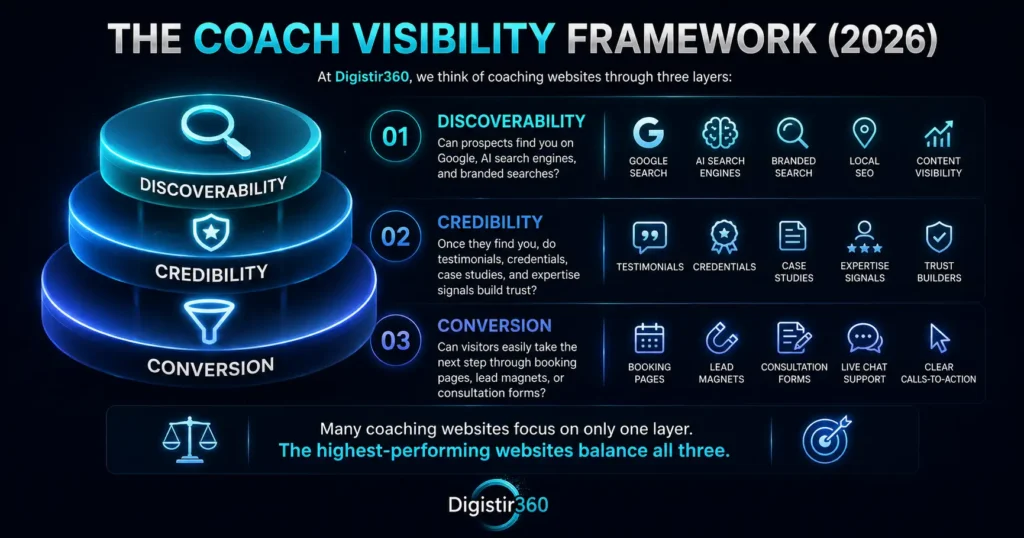
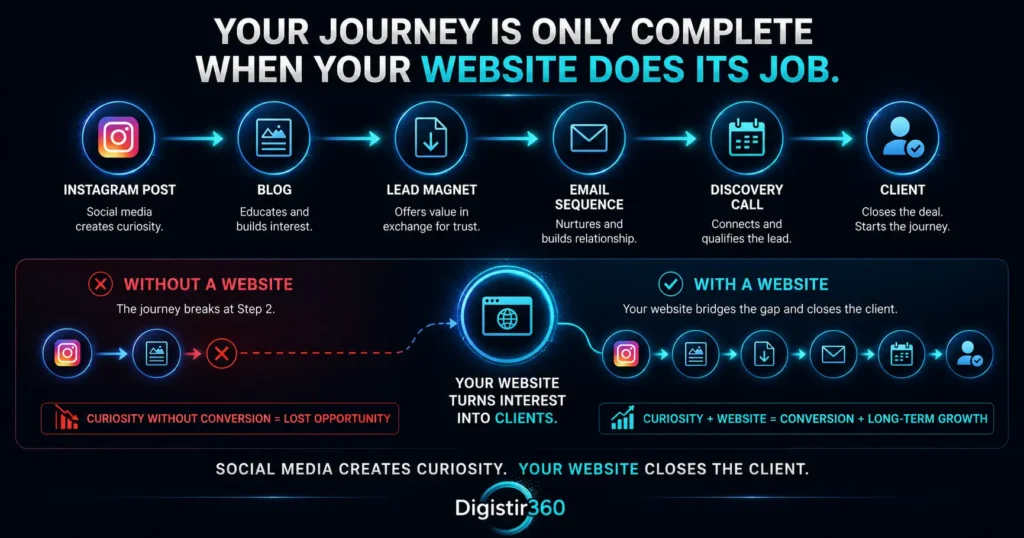
As a coach, your personal brand website serves as your official address. If a potential client stumbles across your post on Instagram, got intrigued. They type your name into Google.
Nothing comes up. No website. No structured bio. No proof of your methodology, results, or credentials. Just a social profile link that loops them right back to where they started.
They click on the next coach instead.
This is happening every single day, to coaches who are genuinely talented, but invisible where it matters most. A personal brand website is the single most important asset in your coaching business.
This guide breaks down exactly why and what the best website for coaches actually needs to do in 2026.
Table of Content
The Coaching Industry Has Changed in 2026
The coaching industry crossed $5.34 billion globally and is projected to keep climbing. That sounds like great news, until you factor in what’s happening on the other side of the table.
Buyers are overwhelmed. AI tools have flooded every platform with polished content, generic advice, and coaches who look credible until you dig one layer deeper.
When someone is considering investing $2,000, $5,000, or $15,000 in a coaching program, they don’t just scroll through your feed and hand over their credit card.
They research and compare. How are your legitimacy, credentials, and testimonials better than those of your competitors?
A 2025 ICF Global Coaching Study confirmed that prospective coaching clients increasingly rely on online information like websites, reviews, and structured digital profiles to evaluate credibility before booking a session.
Why do coaches need websites in 2026? Because buyers now research before investing. A personal brand website is where trust is built, authority is demonstrated, and high-ticket clients make the decision to book. Without one, coaches lose leads to competitors who look more credible online.
Social Media Followers Don’t Equal Authority
Algorithms Control Your Reach
Every platform you post on has one job: keep people on the platform. Do not send them to you. Instagram, LinkedIn, X, and TikTok all throttle organic reach whenever it serves their advertising model.
A post that hit 40,000 people last month may reach 4,000 this month, and there’s nothing you can do about it.
Your follower count is not your audience. You can’t be your business on that.
A Website Is Digital Real Estate You Own
A personal brand website is the one digital asset that no algorithm controls. In the last year, Google has released 4 major updates and policy changes.
If it is your domain, your content, your conversions, that fundamentally creates a different kind of authority.
Websites Create Buyer Confidence
Think about the last high-ticket purchase you considered. Did you buy based on a single social post? Almost certainly not. You visited a website. You looked for an “About” page with real credentials. You read testimonials. You looked for evidence that this person knows what they’re doing.
What a Personal Brand Website Actually Does for Coaches
Builds Instant Credibility: A well-designed website signals investment, professionalism, and seriousness. When a prospect lands on a clean, authoritative site with clear positioning, a compelling story, and visible social proof.
Helps You Rank on Google: Social media profiles rarely rank for competitive coaching keywords. But a website with SEO-optimized pages, a blog, and structured content absolutely can.
Generates Leads While You Sleep: Once live and optimized, a website works 24/7. A prospect in a different time zone reads your blog at 2 a.m., downloads your lead magnet, and wakes up in your email sequence.
Position You as an Expert: When your content answers the specific questions your ideal client is Googling, you’re not just another coach. You’re the go-to authority on that topic.
Creates a Central Hub for Content: Creating various content like YouTube videos, LinkedIn articles, blogs, etc. acts as a central hub.
Improves High-Ticket Conversions: Discovery calls convert better when prospects have already warmed up through your website.
Helps Visibility in AI Search: AI Overviews, ChatGPT, Perplexity, and voice search optimization strategies increasingly rely on structured, authoritative web content when generating answers. Coaches without websites simply don’t exist in these AI-generated answers.
Helps Coaches Stand Out: It’s easy to post content on social media, but building a website, posting, engaging, and sharing thought leadership content consistently differentiates you instantly.
Why AI Search and AEO Make Websites More Important Than Ever
The way people find coaches has undergone a fundamental change. People prefer a simple ChatGPT text over typing a long query into Google.
Here’s the critical implication: AI engines don’t work the same way as Google. These GPT’s cite.
When a user asks, “Who is the best life coach for career transitions?”, an AI-powered search engine scans the web for structured, authoritative content and synthesizes an answer. Coaches who have optimized websites with clear expertise signals, structured FAQ content, schema markup, and Answer Engine Optimization (AEO) are far more likely to be named in that answer than other coaches.
The Best Website for Coaches Includes These Essential Pages
Home Page
Your home page has one job: make the right visitor immediately understand who you help, how you help them, and what to do next. Lead with a benefit. Keep it scannable, fast-loading, and conversion-focused.
About Page
This is consistently the most-read page on any coaching website and the most underutilized. Add your story, your methodology, your credentials, your “why.”
Services Page
Outline your programs, formats, durations, and outcomes. Avoid vague language like “transformative journey.” Tell the reader exactly what they’ll experience and what result they can expect.
Testimonials Page
People love social proof. Video testimonials outperform texts significantly. Be specific, add numbers, and do not give generic copy-pasted testimonials. “I doubled my revenue in four months” converts better than “She’s an amazing coach.”
Blog Section
This is your SEO framework. A well-planned SEO-optimized blog targeting the questions your ideal clients are searching for answer three things at once:
- they build topical authority,
- attract organic search traffic,
- and position you as a trusted expert before a prospect ever reaches your services page.
Contact / Booking Page
Integrate a booking tool like Calendly (free) so prospects can schedule a discovery call in under 60 seconds. Remove every unnecessary step.
FAQ Section
Beyond answering common objections, a well-structured FAQ page supported by FAQ Schema is a direct AEO asset that improves visibility in AI-powered search results.
If you’re a coach ready to build that site rather than DIY it, our website design services are built specifically for coaches, freelancers, and clinics.
Common Mistakes Coaches Make With Their Websites
“The biggest mistake we see isn’t poor design. It’s unclear positioning. A coach may have years of experience, but if visitors can’t immediately understand who they’re helping and what outcome they create, the website struggles to convert.”
– Jyostna, Founder, Digistir360
- Generic messaging: Niche down to a specific audience and transformation.
- Weak personal positioning: Listing certifications before listing results. Your client doesn’t care about your ICF credential. They care whether you can solve their specific problem.
- No clear call to action: If a visitor can’t figure out what to do next in under five seconds, they leave.
- Poor SEO foundation: No keyword research, missing meta descriptions, and no internal linking strategy are not going to help you.
- Slow loading speed: Pages that take more than three seconds to load lose over 40% of mobile visitors. Improve your technical SEO.
- Cluttered layouts: Edit ruthlessly. Have one clear message and stick to it.
- Ignoring mobile: Optimize your website for both mobile and desktop users.
Personal Brand Website vs. Social Media: A Direct Comparison
The smartest coaches use social media to drive traffic and their website to close clients. Here’s exactly why.
| Algorithm decides the reach | Personal Brand Website | Social Media Profile |
| Ownership | Fully owned by you | Platform-controlled |
| Authority | Deep, structured, lasting | Surface-level, ephemeral |
| Discoverability | Google & AI search & voice | Platform search only |
| Longevity | Content lives indefinitely | Posts decay within days |
| Branding Control | Full design and copy control | Constrained by platform templates |
| Conversion Potential | End-to-end funnel capability | Limited, DM-dependent |
| Reach Control | SEO-driven | Algorithm decides reach |
| AEO / AI Search | Indexable by AI engines | Rarely cited by AI answers |
| Lead Capture | Email opt-ins, forms, funnels | Follower count |
How Successful Coaches Use Websites to Attract Clients
The best coaches treat having a personal brand website as an active client acquisition system.
SEO Blogging: Answer the exact questions your clients are Googling. One well-optimized article can generate qualified leads for years.
Lead Magnets: Offer a free checklist, guide, or assessment in exchange for an email. Turn social followers into leads you actually own.
Webinar Funnels: Promote a free training on social, host it on your site, convert it into a high-ticket offer. Your website ties the journey together.
Case Studies: One specific, results-driven client story converts better than a hundred generic testimonials.
Email List Building: Your follower count can vanish overnight. Your email list cannot. Build the asset you own.
What We Found Reviewing Coaching Websites
We reviewed 50 coaching websites across executive coaching, leadership coaching, life coaching, and business coaching.
Our review found:
- 68% lacked a dedicated FAQ page
- 54% had no visible case studies
- 61% relied heavily on generic messaging
- Only 22% regularly publish educational content
Signs You Need a Better Personal Brand Website for Your Coaching Business
If your leads mostly come from DMs and word of mouth, your business is entirely dependent on you showing up every single day. The moment you step back, the pipeline slows down.
Charging higher prices also becomes difficult when prospects cannot find enough proof of your work online. No testimonials can be easily found. No Google presence. No clear story of what you do and who you have helped.
Inconsistent branding across platforms does not help either. When your tone, visuals, and messaging look different everywhere, it creates doubt, even if unintentionally.
And if every algorithm update makes you nervous about your reach, that is worth paying attention to. Visibility that depends entirely on a platform is visibility you do not really own.
If any of this feels familiar, a well-built website is one of the most practical steps you can take to make your coaching business more stable and sustainable.
What Coaches Risk by Waiting and What the Ones Winning Right Now Are Doing Differently
Every day you are without a personal brand website, someone else gets the client you could have had. Prospects searching for a coach in your niche find the ones who show up on Google. You simply do not come up.
Platform dependency is a real risk.
Organic reach on Instagram and LinkedIn has dropped significantly over the past couple of years, and coaches who relied solely on those platforms felt it.
The ones who stayed steady had one thing in common: a website bringing in traffic regardless of what any platform decided to do.
Without that, lead generation is unpredictable. Charging higher prices is harder to justify. And the gap between you and coaches who have built a proper online presence keeps widening.
The coaches doing well in 2026 are the ones prospects can find, research, and trust before ever getting on a call. They show up when someone searches.
Their personal brand website answers questions before a prospect even thinks to ask them.
That kind of presence takes time to build. Which is exactly why starting now matters more than waiting for the perfect moment.
Ready to Build Your Personal Brand Website with Digistir360?
Social media builds reach. A website builds a business. It works for you around the clock, turns visitors into leads, and gives prospects a reason to choose you before they ever get on a call.
If you are ready to stop depending on platforms you do not control, Digistir360 can help you build a website that actually does the work.
Frequently Asked Questions
Why is personal branding important in 2026?
The coaching market is crowded. A strong personal brand makes you recognizable and trustworthy before a prospect ever speaks to you.
Why does your business need a website in 2026?
People search Google and AI tools to find and vet coaches. Without a website, you do not show up in that process, and someone else gets the client.
What is the 70 30 rule in coaching?
70 percent of your time goes toward serving clients. 30 percent goes toward growing your business. A good website supports that 30 percent by attracting and warming up leads for you.
What are the 6 benefits of having a personal website?
Instant credibility, Google visibility, 24/7 lead generation, full control over your story, a home for all your content, and better conversion rates before the first call.
What are the 7 pillars of personal branding?
Clarity, consistency, credibility, content, community, character, and visibility. Together they shape how people find you, perceive you, and decide whether to trust you with their money.